Friday, 11 May 2018

Vietnam – Beyond the saga of War

Visiting the Countries in South East Asia had been in my wish-list for some years; Myanmar and Siam Reap happened a while ago; so Vietnam was a predictable choice while deciding for a summer holiday. The rich lineage of Indian History being the reason, Danag was the highlight of the seven days itinerary; Hanoi and Halong Bay were fitted in for their popularity among tourists. We took an early morning flight to Hanoi, in order to utilise the full day; our two nights Halong Bay Cruise was scheduled for the next day itself. The journey was seamless with hardly 1hr 35 minutes of flying time; the hotel car arrived on time to pick us up at the most orderly and clean airport. The weather was very pleasant even in end of April and a respite from sultry Bangkok summer.

We stayed in Old Quarter of the city which basically had been the French residence during the colonised days. The place was a heritage district with symmetrical alleys full of French architecture, scenic parks and a lake breathtakingly beautiful. The grand official buildings of the old era were now converted into Museums, Corporate offices, Police station etc.; the Opera house stood by its past glory still serving the purpose though. The boulevard around the Opera House somehow reminded of the Champs -Elysees of Paris, probably because of its planning. After an early check in that was graciously facilitated by our boutique hotel, we headed for the National Museum of history that primarily housed the remnants of the revolution against French occupation and the Archaeological Museum that housed artefacts of Champ Kingdom (termed as Champa Desha ancient by Indian sailors). The numerous coffee shops with low height stools and rich aroma indicated towards the affinity of the locals for the caffeine drink that surely were induced by the French Occupants. 


The Archaeological Museum


Hanoi market


While making our way towards the Museums on foot, we had to ask for guidance at roadside; people were friendly, but language became a barrier for any help. One rickshaw puller came to our rescue with his broken English that finally led us to our destination. He followed us till the Museum and offered a city tour in his rickshaw, we politely refused. We finished our visit in no less than one and half hours and then started strolling towards the City Centre. In front of the Opera House, the same guy came to our help; this time offering to click picture of both of us together. We gave in and decided to take the ride of half an hour in 2.5 Lac Dang (roughly 750 INR), our most expensive rickshaw ride ever. I was a bit cross with my husband for not bargaining too hard, ‘consider this as a reward for his perseverance’ was his response.
The Opera House
The boulevard

The Rickshaw ride
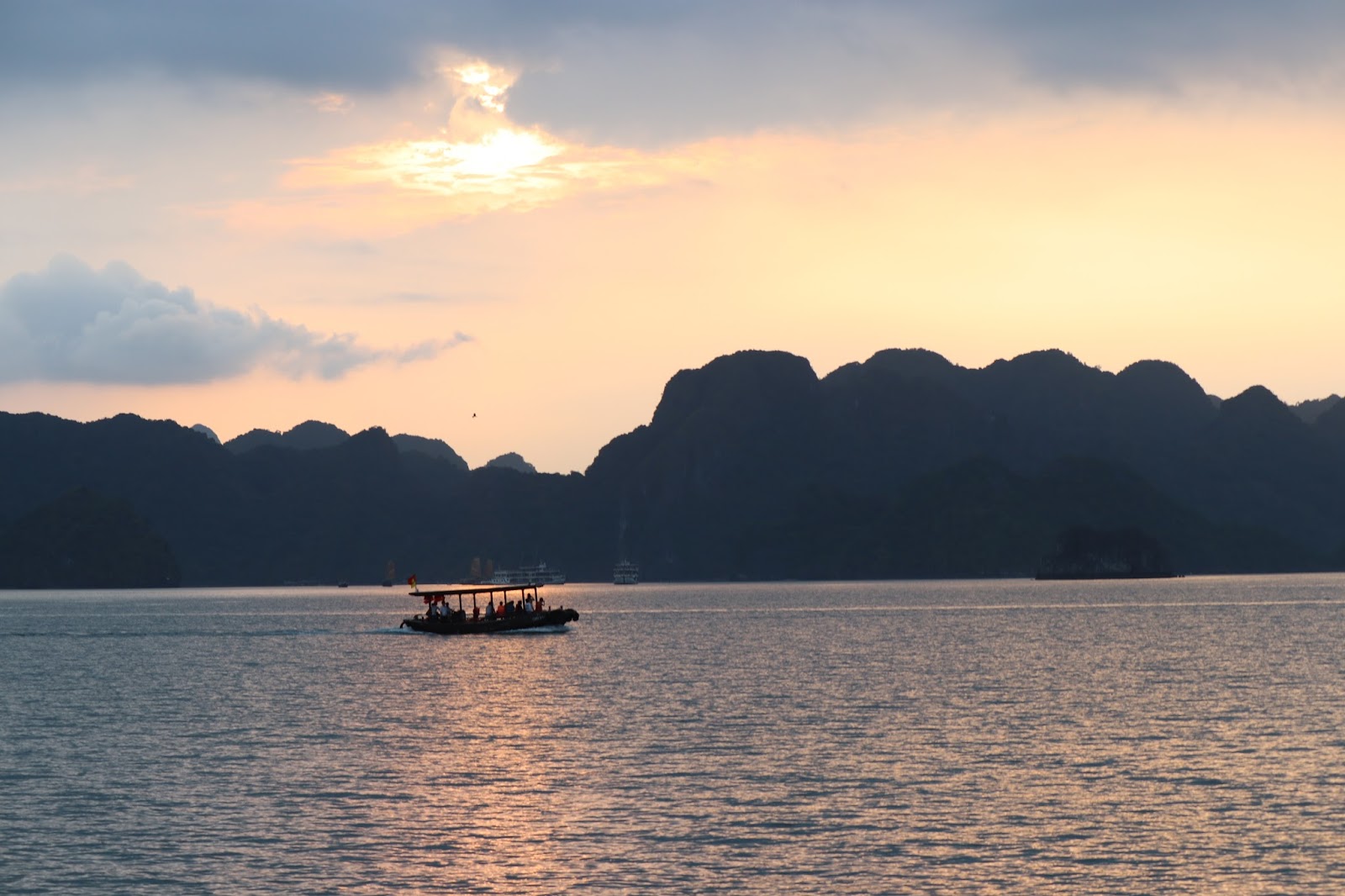
Next day sharp at 7.30 in the morning we were picked up from our hotel by the Cruise Company (Paradise Elegance) vehicle. It took three hours to reach Halong Bay that included a stopover at an elaborate Handicraft shop that offered good stuff in reasonable price. After light refreshment at their Bayside Hotel, we were taken towards our Junk; with previous experience in an Ocean Liner in Singapore Cruise, I found the ship quite small, though pretty. Surprise came as we boarded; an enormous reception with showering of rose petals, cool drink, wet towel to a welcome dance by the staff absolutely stole my heart. Our surprise wasn’t over I realised as we entered our suite (this luxury cruise offered suite with private balcony for all boarders), it could easily put to shame a specious luxury hotel room. From my previous cruise experience (despite staying in a superior cabin), I expected a much smaller set up, especially the Toilet, I was awestruck. It was a three storey ship with 1st two floors for boarding, top floor for restaurant and the Deck top elaborately equipped for Sun bathing and Sun down drink. The elaborate spread at breakfast and lunch and the personalised four course dinners that were served every night surpassed my imagination in terms of quality and variety. The beauty of the Bay that we enjoyed in the course, I would rather express through few snapshots than my limited words.


view from hilltop
At night
As part of daytime activities, we were taken to the amazing Sung Sot Cave, Titop Island (for 360 degree hilltop view), floating village and also for Kayaking. The experience of Kayaking for the first time (with my impeccable expertise) and eating freshly caught Seafood were both unique in their own way and worth special mention in the narrative.


Song Sat Cave
The cave

Fishermen's temple in floating village

That Titop Island
After the cruise, we came back to Hanoi and stayed in the same hotel for one more night. We spent that evening in Vietnamese Spa (they will soon be a competition to Thailand for sure), took dinner at a Lakeside restaurant and watched a water puppet show that was simply astounding.
Hanoi at night

The Lake

The water puppet show

Coffee culture

Next day morning we flew to Danag, an hour of domestic flying with amazing view of a long coast and lush mountain valley while landing, made the journey memorable. In Danag we decided to stay by the Sea in the New city as it would be near to the Danag National Museum and also nearer to My Son, the UNESCO site for ancient Champ Kingdom. For the travellers not so interested in ruins, the ancient port city named ‘Hoi An’ could be a good option and a different experience altogether.

The beach was long and pristine, encircling the entire city coast and absolutely a visual treat. We were really enthralled even being exposed to the exotic beaches of Thailand. Sitting at any of the beachside restaurants with a Sundown drink could be a cherished experience for holidaymakers.
Danang beach


Sunrise
The City was newly built and world class in terms of smart planning and good maintenance; the riverside boulevard and the area around were interesting to stroll around. Vietnam in general was a great place for shopping, especially handicrafts, clothes and shoes, Danag had specific market for these domestic products.
The bouleavard

Fennel soaked chilled water complementary
The Dragon bridge
The Danang National Museum housed amazing collection of remnants from the My Son ruins which was both intriguing as well as explanatory.


My Son artefacts


We went to My Son the next day on a half a day trip, taking a stopover at Marble Mountain on the way. In Marble Mountain there was elevator to reach to the top; the picturesque view of the city, sculptures, a Pagoda and a cave temple made the visit worthwhile. My Son Sanctuary was a cluster of Hindu Temple ruins ranging from 8th to 14th Century surrounded by a forest valley between two mountains and a stream. Government of India patronises this UNESCO site because of its strong Indian lineage. The nostalgic environment, revealing architecture and mesmeric landscape were more than enough to satisfy a history lover (me) and a photographer (My husband); we came back to the city happy and content.


The Lady Buddha

Cave Temple at Marble Mountain

Inside the temple

My Son Ruins

The Mahalinga


Next day we took the flight back home, saying goodbye to Vietnam only for this time; as in our mind we both were nurturing the idea of a future trip, may be to explore the other coastal areas of the beautiful and friendly nation.


All photographs of this blog are personal property of Mr. Dilip Pal. Copyright (c)dilippal 2018
Copyright (c)ananyapal2018 ALL RIGHT RESERVED 


Friday, 27 April 2018

Angkor – Astounding monuments of a glorious past

I am notoriously infamous within the family for my passion for history; the other members prefer the term fanaticism instead of passion and often refuse to accompany me for a vacation in historical places. Hence, my long time desire to visit Angkor in Cambodia remained supressed for past few years. This time before the Songkran holidays surprisingly, my worse half (husband) came up with the idea of visiting Siam Reap. He cited history being the reason; but I thinly suspected, a failed attempt to do a last minute plan for Japan during Cherry Blossom made him enthusiastic for the trip. Anyway, we packed our bags and started for Siam Reap from Bangkok (flying time only an hour) during the most unfavourable time of the year (April is the hottest month in Cambodia). ‘We will visit the temples in the early hours only I assured him’, ‘and what will we do for the rest of the day?’ he wasn’t so sure about my clemency. ‘Why, we will be in the Museum of course for the spare time’; ‘count me out’ was his response to my suggestion.


The day we arrived, we planned for a Sunset trip to the Tonle Sap Lake; the hotel arranged for the car and a guide. The boat ride in the afternoon Sun wasn’t that unpleasant, the floating village was an interesting site. We were informed that the entire village keep moving either in the canal (during winter) or in the main lake (during summer) depending on the season and water level. The Sunset from the rooftop of a floating restaurant was most spectacular, though the demonstration of live pythons by small kids and the crawling alligators in a ditch in the restaurant didn’t excite me at all.  


Next day we started from hotel at 4.45 am along with a guide for Angkor wat; we bought a three days pass on our way. After reaching the site in semi darkness we took position in the bank of the moat facing eastern wall of the temple. At 6 am the glimpse of dawn started painting the sky behind the Temple towers, which were designed after Mount Meru (The Mountain situated in Heaven as per Hindu Mythology). I was awestruck by the mystic beauty of the Temple in the shadow of the rising Sun; the magnificence of the archaeological wonder unfolded slowly as the daylight appeared.


The intimidating Sarpent gates, the vast compound, the intricate stone carvings and above all the wall relics of narrative scenes from Hindu Mythology were the causes for this 12th century ‘Varaha Vishnu Lok’ temple to be considered world’s one of the  most spectacular monument.

The Angkor Thom or the ancient citadel built by King Jayavarman VII (Post Vishnu temple creator King Suryavarman II era) was the seat of a mighty Kingdom; the enormous gateway with the elaborate sculpture of Churning of ocean was a remnant of that. In my limited experience of ruins, I have never witnessed such thing before.   
The Gate

Churning of Ocean

The Bayon Temple depicted the face of Lokeshwara (an avatar of Lord Buddha) on the outer sculpture of each temple tower including the main building. The surrounding greenery and the peaceful ambience added a certain character to the temple.


The Bayon Temple


Depiction of Lokeshwara

The Ta phrom or Rajavihara temple, another significant temple built by King Jayqavarman VII was totally taken over by giant trees and submerged in the jungle. It was re-discovered and subsequently restoration work was taken up jointly by the Government of India and Cambodia in early 21st Century. The architecture of this temple reminded of the ancient Buddhist temples of India. The pillars and walls of the Ta Phrom temple and the relics and statues peering from the arrogant trees radiated a deep sense of nostalgia ; it wasn't difficult to sense the forgotten era simply sitting at a corner. 


Ta Phrom Temple

An Apsara smiles from behind

The Angkor National Museum was great treasure for tourists interested in history; a visit to this place is must to understand the temples and Khmer culture truly. The respite from extreme sultry weather, an elaborate cafĂ© and a most interesting souvenir shop also added to the significance of the Museum.


The indomitable spirit of Sonkran festivity was visible everywhere, from Angkor temple to the streets of the downtown. Enthusiastic locals were busy with waterguns splashing powder water at passerbys, though didn't aim at reluctant tourists. The numerous massage parlours at astonishingly cheap rates explained neighbouring Thai influence. The woodwork, spices (especially pepper), Kmer style paintings and bead jewellery were few things one could pick up; for more serious buyers there were art gallaries with wonderful artefacts. The street had many Indian restaurants offering authentic North as well as South Indian food at a very reasonable price. We tried Khbmer cuisine at a signature Cambodian restaurant on Khmer New Year day and the food was amazing, with a wonderful blend of oriental and Indian taste.


Sonkran Decor

Sonkran Decor

The Indian influence was unmistakable from temples to food and even in the Khmer language. The Petrol pumps showed signboard of selling 'Tela' (Oil in Sanskrit), fish was refered as 'Maccha' (Pali variation of Sanskrit Matsya). People were extremely humble and friendly, years of civil war and subjugation couldn't break their spirit for sure.

Overall our three days trip was a dreamlike tour to a land of history and heritage; one of the items in my bucket list being tick marked.