Act of courage does not know boundary, nor does it seek any motivation. Some people are born to be brave when it is needed the most and emerge as real heroes beyond any prejudice. Here are the stories of a handful of such heroes belonging to the Countries not directly affected by the World War II. They acted beyond the call of duty, without any expectation for recognition.
Rifleman Lachhiman Gurung (British India)

Gurung, born in Nepal joined British Indian Army in December, 1940 at the age of twenty seven. He was a rifleman in 4th Battalion of 8th Gurkha Rifles. In May, 1945 his Battalion as a part of 7th Indian Infantry Division was fighting against fierce Japanese soldiers in Burma (modern day Myanmar). They were ordered to cross the river Irrawaddy and attack Japanese forces to the north of the road from Prome to Taungup. Retreating Japanese force headed towards Taungdaw, where 8th Gurkha Riffle was posted. Gurung was manning the most forward post of his platoon along with two fellow riflemen. In the earliest hour of May 13, around 200 enemy soldiers attacked his post with sudden vigor. The fight was unmatchable, very soon his fellow soldiers fell. Gurung continued to defend his post singularly. Enemies started hurling grenades to clear the trench. Twice Gurung hurled the live grenades back. Third time the grenade exploded in his right hand blowing off fingers, shattering his right arm and damaging face and right side of his body. Grenade damaged his body, but could not dampen his spirit. Wounded and alone he continued loading and firing with left hand. He maintained calm and defended the post for four hours till the reinforcement came. Later on, it was reported that thirty one Japanese were lying dead around his position that he took with one arm.
He was awarded the Victoria Cross in December, 1945.
He lost his right eye and right arm but continued to serve in 8th Gurkha Riffle, by then a part of newly independent Indian Army.
Lieutenant Adnan Bin Saidi (Malay Regiment)

Adnan Bin Saidi was born in Solangor district of Malaysia. He joined the Malay Regiment of British Army in 1933 at the age of eighteen and raised to the rank of 2nd Lieutenant, heading 7th Platoon, ‘C’ Company. In late 1941, Adnan was posted in Singapore. When Japanese forces attacked Singapore in 1942, he was commended the defense of Pasir Panjang Ridge, the last British bastion. Defending Pasir Panang was crucial, since; the main storage of ammunition, other military supplies and hospital were located there. On May 13, Adnan and his troop resisted the impending Japanese force at the Ridge. Enemy soldiers grossly outnumbered Malay Regiment, but the fighting spirit and courage of Adnan and his men defused any effort to take over the Ridge. Japanese troops got frustrated with the steep resistance and heavy casualty. The day long battle took a toll on Malay Regiment as well, forcing them to retreat to the near by Opium Hill. The battle continued there with diminishing supplies of Malay Regiment and fresh reinforcement of Japanese force. Each man in Malay Force under Adnan’s leadership took a vow to fight till death and defend the Ridge. By next day afternoon, Adnan’s Battalion ran out of ammunition and entered in combat fight with the enemy. It was an impossible act of courage of greatest height that resulted in gruesome death of each member of his troop, as Japanese soldiers were known for their cruelty in combat fight. Adnan was mortally wounded, but refused to surrender till his last breath. His fierce resistance made the enemy ruthless, as they were already infuriated about the casualties. As a result, Adnan was dragged and hung from a tree by his legs and brutally bayoneted. The torture continued with repeated slitting of throat and finally burning of the body. His body was never recovered.
A war memorial plaque has been erected in Kent Ridge Park (near the battlefield) in remembrance of the bravery and supreme sacrifice of Adnan and his men.
Corporal Oswin Kenneth Sanderson (Australian Cavalry Regiment)

New Guinea, an island to the immediate north of Australia and an erstwhile Australian colony; was strategically important for both Japanese and Allied forces. Japanese needed the island for Air and Naval base in order to operate in the Central Pacific front. Australians wanted to get back their hold on the Island; United States required driving out Japanese forces for taking back the control on Central Pacific. In November 1942, Australian and United States forces attacked the main Japanese beachheads at Buna, Sanananda and Gona. The terrain was a commander's nightmare as the deep rain-forest prevented the deployment of large army. On the north shore large mangrove swamp slowed overland movement. Heavy monsoon rains turned the ground glue-like muddy that made walking tiresome. Diseases like Malaria, Dengue, Scrub typhus and dysentery accompanied the monsoon and claimed many lives. The dense rain-forest afforded excellent concealment to stubborn defenders, making coordinated overland attack nearly impossible.
On the road to Sanananda, Japanese forces held a series of perimeters (an area of around 200 yards each); bristling with machine guns and snipers. They were hidden in the jungle, protected by swamps. The attacking Australian troops faced withering fire poured from the hidden defenses. Most of the attacks ended before even gaining enemy line. On 19th December, 1942 an Australian cavalry regiment went into its first action by foot. They started attacking from Huggins road and pushed forward in the scrub along the sides of the road. Corporal Oswin Kenneth Sanderson aged twenty two was in the second troop of the forwarding battalion. Suddenly a machine gun open fired from no where and shot a soldier in front of Sanderson while crawling over a log. Sanderson reached to the man to provide help. By then another man from his section crawled to the log too. Rest of the troop waited anxiously to proceed. Sanderson started firing from his rifle to draw attention of the Machine gunner in order to provide cover for the troop. He estimated the location of the enemy Gun to be around thirty yards and hurled grenades towards the hidden position. Then he borrowed the Owen gun from his companion, stood up and open fired towards the enemy. He expected from the counter fire two Japanese soldiers to be manning the machine gun. Sanderson took quick decision and asked his fellow mate to accompany him to charge the enemy position. He jumped up and ran fast reaching in no time the hidden post which proved to be only five yards away. By the time the other soldier reached, Sanderson had killed all the Japanese soldiers manning the post; in turn sacrificing his own life. Had it not been for him, the machine gun would have wiped out the troop; destroying any chance to get forward.
Flight Lieutenant Leonard Joseph Birchall (Royal Canadian Air Force)

Birchall’s unit, 413 Squadron RCAF was posted in Sri Lanka in April, 1942 to carry out area surveillance for any Japanese activity. On 4th April, at late afternoon; Birchall along with his crew, was on a long patrol in a large PBY Catalina floatplane. All of a sudden he noticed a tiny smudge in the southeast horizon. Curiosity prompted him to fly towards the mysterious smudge for investigation; resulting in complete detachment from the base. His worst fear came true; it was a fleet of the Imperial Japanese Navy. He decided to fly even closer to make note of the details of the fleet. Risking the danger to be spotted he flied towards the fleet and successfully recorded the details of numbers course and speed. To his horror he discovered five aircraft carriers, four newer class battleships, attended cruisers and destroyers heading towards Colombo. By then, his plane was already spotted; a number of Japanese Zero fighter-planes Chased and surrounded in no time. There were twelve of Japanese Zeroes against a lone Catalina piloted by Birchall. Knowing their fate too well, the crew members radioed two encoded messages to the base with all the details of the Japanese fleet. His Catalina, badly shot up, damaged beyond recognition; caught fire and crash landed in the sea. The crew wearing life jackets tried to evacuate the ill fated plane but, could not escape the continued attacks of the Zeroes from above. Everyone except Birchall and a few succumbed. Survivors were picked up by a Japanese destroyer. They were brutally tortured to determine whether any message had been radioed. Birchall continuously encouraged his mates during the interrogations and refused to reveal whether he had been successful in alerting the base. Finally he was taken as prisoner of war and deported to one of the dreaded Japanese POW camps.
Prior information allowed the Indian Ocean fleet of Royal Navy to prepare well in counter fighting the imposing Japanese fleet. Allied forces were saved from another Pearl Harbour.
Birchall was awarded Distinguished ‘Flying Cross’ for his act of courage. He was also awarded Order of British Empire for the exemplary courage shown in protecting fellow prisoners in POW camp.
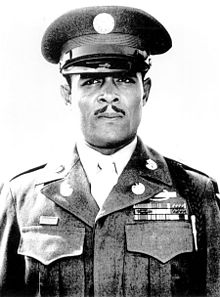
Staff Sergeant Edward A. Carter, Jr. (United States Army)
Carter, born in Los Angeles in 1916 was the son of missionaries; father an Afro American, mother an Indian. He grew up in India and moved to Shanghai, China. There he joined the Chinese Nationalist Army fighting the invading Japanese and later the Abraham Lincoln Brigade (American Volunteer unit) fighting the Spanish Civil War. Carter joined the United States Army in 1941. He was part of the Seventh Army Infantry Company of 56th Armored Infantry Battalion (a part of 12th Armored Division). His unit was among many provisional companies established during 1944-1945 with special combat training to augment depleted divisions. He was posted near Speyer in Germany.
On 23rd March, 1945, Carter along with three other soldiers was on a routine patrol. He was riding a tank which was suddenly hit by an enemy bazooka fire from a hidden spot across the road. He quickly dismounted and led his companions to an open field under heavy firing. In the process, two of the men were killed and the other seriously wounded. Carter continued and was wounded five times before being forced to take cover. Out of eight German soldiers attacking him, he killed six; capturing rest of the two in combat fight. He used the captured soldiers as shield from enemy fire and re-crossed the field to escape to his unit. The prisoners provided valuable information on enemy troop disposition to his unit.
He was awarded World War II Victory Medal and Combat Infantryman Badge. The Medal of Honor was awarded to him along with nine other Afro- American soldiers posthumously in 1997, since, during World War II Black soldiers were not entitled to this honor.
Doris Miller (United States Navy)
Miller, born in Texas in 1919; joined United States Navy as a cook-third class; one of the very few options available to African Americans in those days. He was posted in the battleship West Virginia that was harbored in Pearl Harbor in December 1941. In the morning of December 7, 1941; Miller was collecting laundry after serving breakfast in the mess when the first of the nine torpedoes was launched on West Virginia by Japanese Aircraft carrier Akagi.
Miller immediately headed for the Battle station; the anti aircraft battery magazine, only to discover it to be totally damaged. Then he helped in evacuating the fatally wounded Captain to a safer space. Immediately after he followed two officers towards the anti aircraft machine guns stationed behind the conning tower. The officers expected him to load ammunitions in the guns but to their surprise they discovered him firing one of the guns without bothering about personal safety. He gunned down six Japanese Aircrafts single-handed. West Virginia was badly damaged by torpedoes and air bombardment. Once run out of ammunition Miller started helping injured crew members evacuating through oil and water. Finally the ship sank without any living crew member in it.
The act of courage of this cook went unnoticed in the Navy record. On December 15, Miller was transferred to the ship ‘Indianapolis’. Finally in May 1942, Miller was mentioned in the list of commendation for actions in Pearl Harbor as an unnamed Negro sailor and awarded the ‘Navy Cross’, first for an African American.
He died two years later in the navy battle at Tarawa when his ship was torpedoed by a Japanese submarine.